
Scotland 2018 · Page 5
- Dates
- 2018
- Route
- Appeldorn - Stirling - Stonehaven - Inverness - Durness - Edingburgh
- Distance
- 3.650 km
- Travel map
- Show on map
- Campsites
- 7 sites
- Photos
- 515
Dunnottar Castle lies near the town of Stonehaven in Aberdeenshire, Scotland. It rises proudly on a rocky headland about 50 metres high and offers a spectacular view of the rough North Sea. The origins of the fortress go back to the 3rd century, when it served as a Pictish settlement. Over the centuries Dunnottar Castle was developed into a mighty fortress that played an important role in the Scottish Wars of Independence.
Dunnottar Castle is closely linked to the history of Scotland. During the Scottish Wars of Independence, the fortress served as a refuge for Scottish heroes such as William Wallace and later for the Scottish crown and the heir to the Scottish throne. Dunnottar Castle also played an important role during the religious conflicts of the 17th century, when it was occupied by Covenanters. The most famous episode in the fortress's history was the siege of Dunnottar in 1651 by Oliver Cromwell and his troops. Although the siege was hard, the defenders refused to surrender and held out until they were finally relieved. This steadfastness made Dunnottar Castle a symbol of Scottish resistance.
The architecture of Dunnottar Castle is impressive and reflects the different eras of its history. Visitors can explore the ruins of the chapel, the tower house, the defensive towers and the walls. The highlight is undoubtedly the tower house, which offers a panoramic view of the surrounding sea. The castle keep, once the heart of the fortress, now houses a small museum presenting artefacts and exhibitions on the history of Dunnottar.
Dunnottar Castle is not only a place of historical importance but also a popular tourist attraction. Visitors can explore the fortress on their own or take a guided tour to learn more about its history and legends. The breathtaking view of the coast and the sea makes Dunnottar Castle a photographer's paradise.
The admission fee of 7 pounds per person is very reasonable, and so we let the castle work its magic on us. 2 hours later we continued our journey, and our next destination was Inverness.
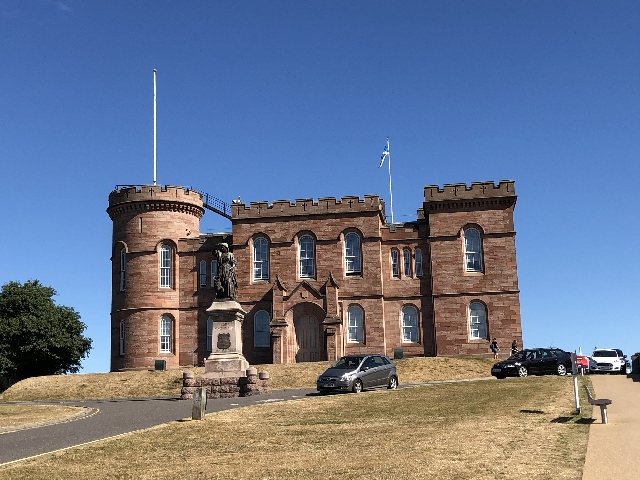
In the late afternoon we reached the campsite in Inverness. The drive there was more than exhausting – we had never experienced so many roundabouts in a row; there was one every 2 miles. The campsite near the centre is nicely situated, and we had a pitch with electricity on the grass. An overnight stay costs 27 pounds for two people with electricity and motorhome. The next morning we set off to explore Inverness. First we visited Inverness Castle, which is right in the old city centre on the river. It is used as a court, and the tower can be climbed for 5 pounds. The view over the city from up here is beautiful, and from here you can go straight to the pedestrian zone and the old part of town.
One of the emblems here is the unicorn, which could be found on many corners. The Victorian Market is also easy to reach on foot. The campsite is on the edge of Inverness and very quiet.
The next morning we set off very early, heading for the waterfalls at Black Water (IV14 9EQ). Our route took us past the famous Loch Ness and then over a very beautiful mountain road further north.
You can park your motorhome directly in the free car park. There are two paths to the waterfalls, one 700 m and the other 1.3 km. For people with physical disabilities this waterfall is difficult to reach, as the paths are very steep and rough in places.
Our next stop on the list was Dunrobin Castle near Brora. After 60 miles we reached our destination. Parking with a motorhome is no problem, and the car park is even free. This really is a dream castle and very well preserved. Admission is 10.50 pounds per person.
After a great tour we went to the Clynelish distillery. If you've been to the castle first and show your ticket at the distillery, you get 50 percent off admission and the tour. We had a great tour with another couple from Germany, followed by a tasting.
But we didn't drink anything, as we wanted to drive on, so the samples were simply packed up and we could enjoy them in the motorhome in the evening.